| Material | Baked clay |
|---|---|
| Size | 21.9 centimetres (8.6 in) x 10 centimetres (3.9 in) (maximum) x (end A) 7.8 centimetres (3.1 in) x (end B) 7.9 centimetres (3.1 in) |
| Writing | Akkadian cuneiform script |
| Created | About 539–538 BC |
| Period/culture | Achaemenid Empire |
| Discovered | Babylon, Baghdad Vilayet of Ottoman Iraq, by Hormuzd Rassam in March 1879 |
| Present location | Room 52, British Museum (London) |
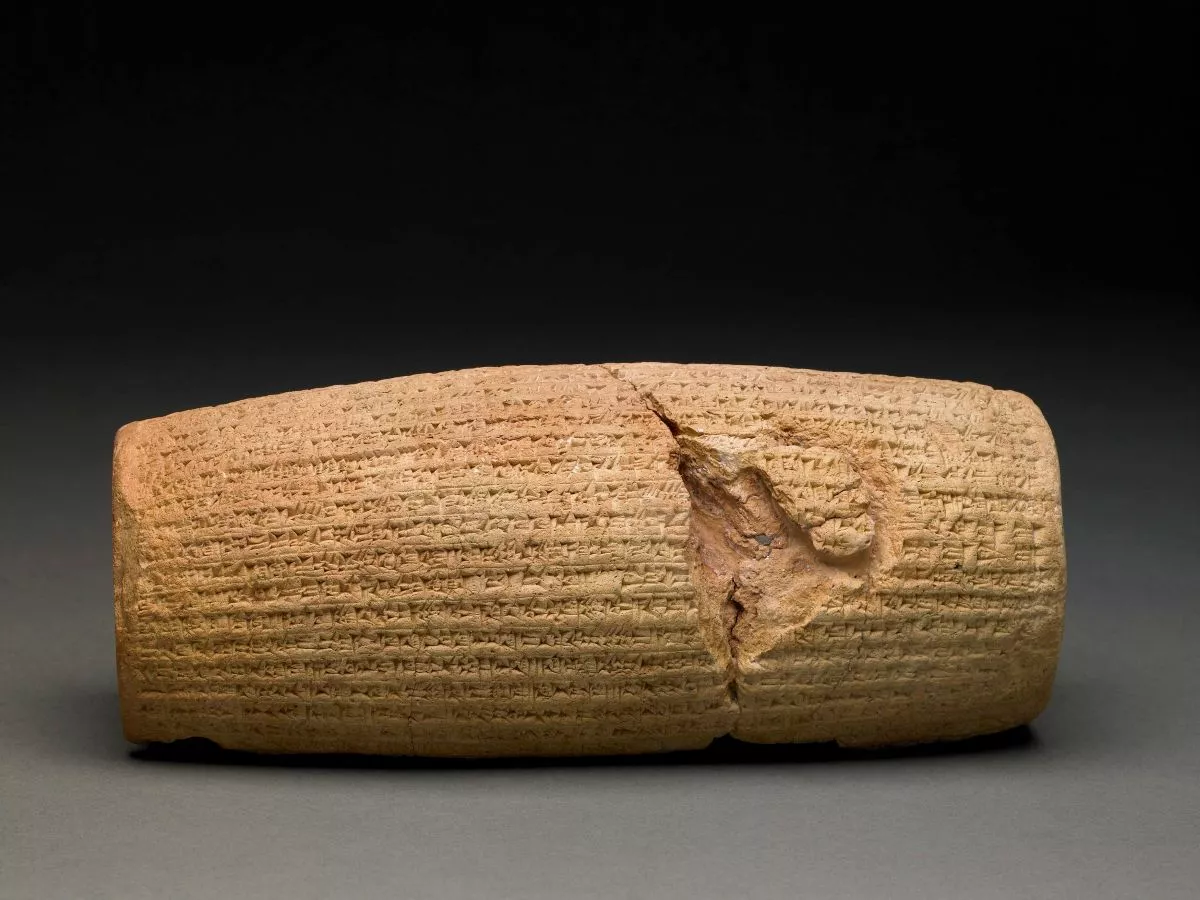
Often called the world’s first charter of human rights, this small clay artifact from 539 BCE tells a powerful story. Commissioned by Cyrus the Great after he conquered Babylon, it records his policies of tolerance, religious freedom, and the return of displaced peoples. Written in Akkadian cuneiform, it not only reflects ancient Persian governance but has inspired modern ideas of justice and human rights worldwide.
The Cyrus cylinder is a clay cylinder; a Babylonian account of the conquest of Babylon by Cyrus in 539 BC, of his restoration to various temples of statues removed by Nabonidus, the previous king of Babylon, and of his own work at Babylon. The cylindrical form is typical of royal inscriptions of the Late Babylonian period, and the text shows that the cylinder was written to be buried in the foundations of the city wall of Babylon. It was deposited there after the capture of the city by Cyrus in 539 BC, and presumably written on his orders.
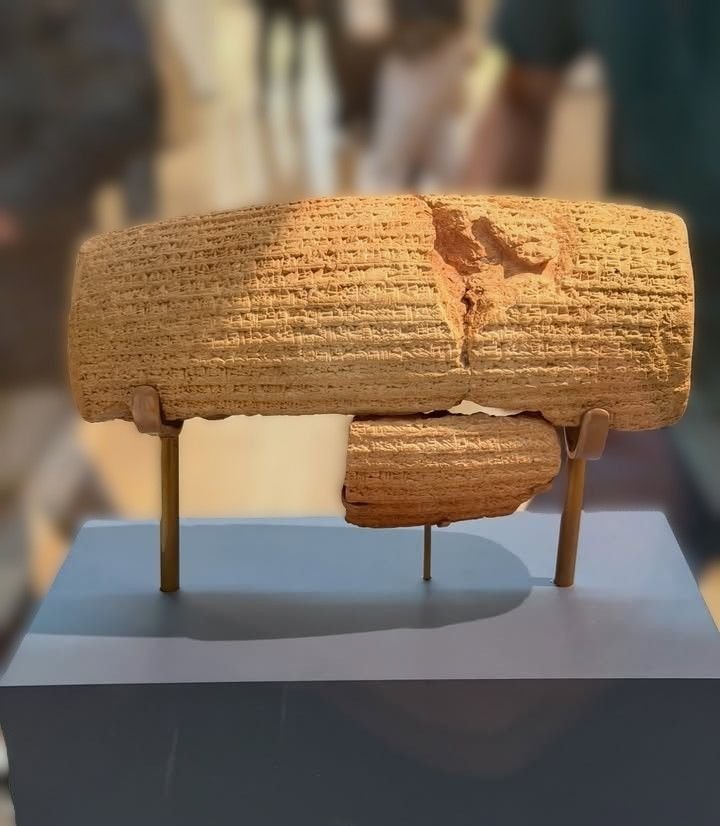
The text is incomplete. It is written in Babylonian script and language and records that Nabonidus, the last King of Babylon (555-539 BC), had perverted the cults of the Babylonian gods, including Marduk, the city-god of Babylon, and had imposed labour-service on its free population, who complained to the gods. The gods responded by deserting Babylon, but Marduk looked around for a champion to restore the old ways. He chose Cyrus, King of Anshan (Persia), and declared him king of the world. First Cyrus expanded his kingship over the tribes of Iran (described as Gutians and Ummanmanda), ruling them justly. Then Marduk ordered Cyrus to march on Babylon, which he entered without a fight. Nabonidus was delivered into his hands and the people of Babylon joyfully accepted the kingship of Cyrus.
From this point on, the document is written as if Cyrus himself is speaking: ‘I, Cyrus, king of the world …’.He presents himself as a worshipper of Marduk who strove for peace in Babylon and abolished the labour-service of its population. The people of neighbouring countries brought tribute to Babylon, and Cyrus claims to have restored their temples and religious cults, and to have returned their previously deported gods and people.
The text ends with a note of additional food offerings in the temples of Babylon and an account of the rebuilding of Imgur-Enlil, the city wall of Babylon, during the course of which an earlier building inscription of Ashurbanipal, King of Assyria (668-627 BC), was found.

This article is published on ArtAddict Gallery where we explore the intersections of art, history, and culture. Stay with us for more insights and discoveries!