Artist: Francisco de Goya y Lucientes
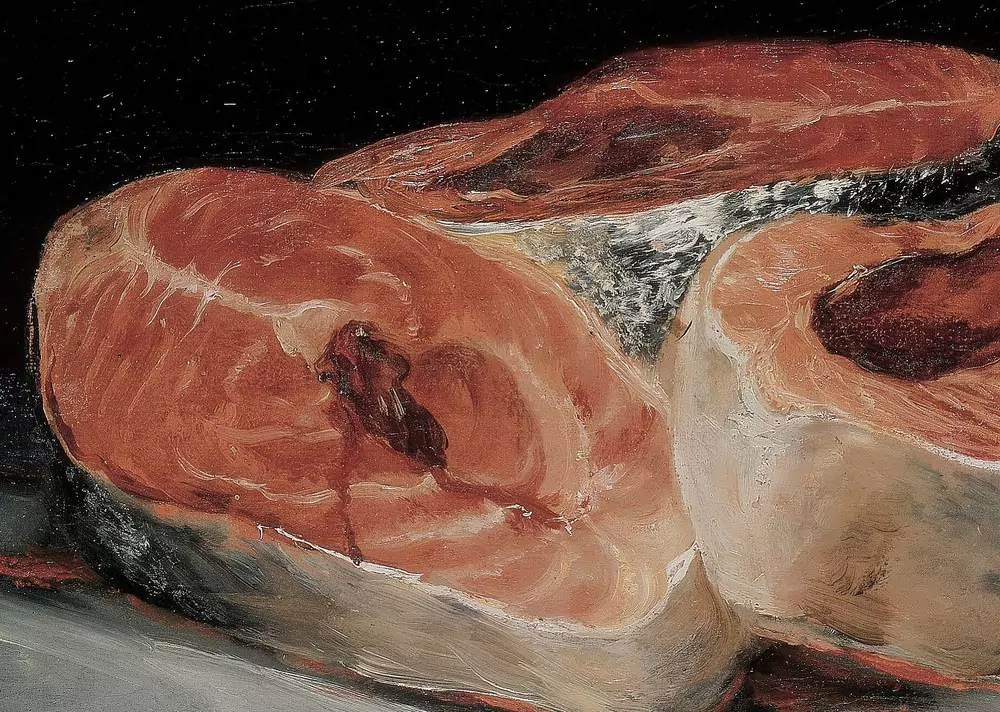
Title: Still Life: Three Salmon Steaks
Date: 1808–1812 Medium: Oil on canvas
Dimensions: 45 x 62 cm
Current Location: Oskar Reinhart Collection, Winterthur, Switzerland
In the early 19th century, amidst the turmoil of the Peninsular War, Francisco de Goya y Lucientes, a prominent Spanish painter, created a series of still-life paintings that diverged from his usual repertoire. One such work, ” Three Salmon Steaks” (1808–1812), stands out not only for its subject matter but also for its profound reflection of the era’s socio-political climate.
The Peninsular War (1807–1814) was a significant conflict involving Spain, Portugal, and Great Britain against Napoleon’s French forces. This period was marked by intense violence, political upheaval, and widespread suffering among the civilian population. Goya, serving as a court painter, witnessed firsthand the atrocities and chaos that unfolded during these years. His experiences deeply influenced his artistic direction, leading him to explore themes that mirrored the harsh realities of war-torn Spain.
Transition to Still Life
Traditionally known for his portraits and historical scenes, Goya’s foray into still-life painting during this tumultuous period is noteworthy. The choice of still life, particularly the depiction of raw and unembellished subjects, can be interpreted as a subtle yet powerful commentary on the prevailing conditions. Art historians suggest that Goya’s still lifes from this era, including “Still Life: Three Salmon Steaks,” serve as allegories for the brutality and bloodshed experienced during the war.
A Reflection of War Through Art
This oil on canvas measures 45 by 62 centimeters and is currently housed in the Oskar Reinhart Collection in Winterthur, Switzerland. The painting presents three salmon steaks, rendered with striking realism, placed against a stark, dark background. The rich, red hues of the flesh are accentuated, drawing immediate attention to the rawness of the subject.
The isolation of the salmon steaks, devoid of any contextual elements or embellishments, emphasizes their raw and unprocessed state. This deliberate choice can be seen as a metaphor for the human condition during the war—stripped of dignity, exposed, and vulnerable. The blood-red tones of the meat further allude to the pervasive violence and loss of life, serving as a silent testament to the era’s horrors.
Symbolism and Interpretation
Goya’s “Three Salmon Steaks” transcends mere representation of food items; it delves into the symbolic realm, reflecting the artist’s internalization of the external chaos. The meticulous depiction of the salmon’s texture and color showcases Goya’s mastery over his craft, while also imbuing the work with a visceral quality that evokes a sense of discomfort and reflection.

The absence of a detailed background or setting strips the subject of any narrative context, compelling the viewer to confront the raw imagery directly. This technique aligns with the Romanticism movement’s emphasis on evoking emotion and individual interpretation. The painting’s starkness serves as a canvas upon which the viewer can project their understanding of the human experience during times of strife.
During the same period, Goya embarked on creating “The Disasters of War,” a series of 82 prints that graphically depict the brutal realities of the Peninsular War. These works, characterized by their unflinching portrayal of violence, serve as a visual protest against the atrocities committed during the conflict. The thematic parallels between “The Disasters of War” and his still-life paintings suggest a cohesive narrative in Goya’s oeuvre, wherein he employs different genres to explore the multifaceted impact of war on society and the individual psyche.
Influence on Future Art Movements
Goya’s innovative approach in “Still Life: Three Salmon Steaks” and his broader body of work have had a lasting impact on subsequent art movements. His willingness to infuse traditional genres with contemporary socio-political commentary paved the way for future artists to explore similar themes. Notably, his influence is evident in the works of Édouard Manet and Pablo Picasso, who also sought to reflect the complexities of their times through their art.
The painting exemplifies Goya’s technical prowess, particularly in his use of chiaroscuro—the contrast between light and dark—to create depth and focus. The illumination of the salmon steaks against the dark background not only highlights their form and texture but also adds a dramatic intensity to the composition. This technique draws the viewer’s eye directly to the subject, emphasizing its significance and inviting deeper contemplation.
Currently, “”Still Life: “Three Salmon Steaks” is part of the esteemed Oskar Reinhart Collection in Winterthur. The collection, renowned for its assemblage of European masterpieces, offers insight into the evolution of art across centuries. Goya’s inclusion in this collection underscores his pivotal role in bridging traditional and modern artistic expressions.
This painting, like much of Goya’s later work, forces us to reconsider the boundaries between art and history. It is deceptively simple—three cuts of salmon, isolated in darkness—yet charged with meaning. The stillness of the composition echoes the silence left in the wake of conflict, while the bold, almost violent use of red reminds us of the cost of war. Goya was not just painting fish; he was painting a world in turmoil, using everyday objects to tell a story that still resonates centuries later.

This article is published on ArtAddict Gallery where we explore the intersections of art, history, and culture. Stay with us for more insights and discoveries!