| Artist | Unknown, from Antioch (modern-day Turkey (Antakya) |
|---|---|
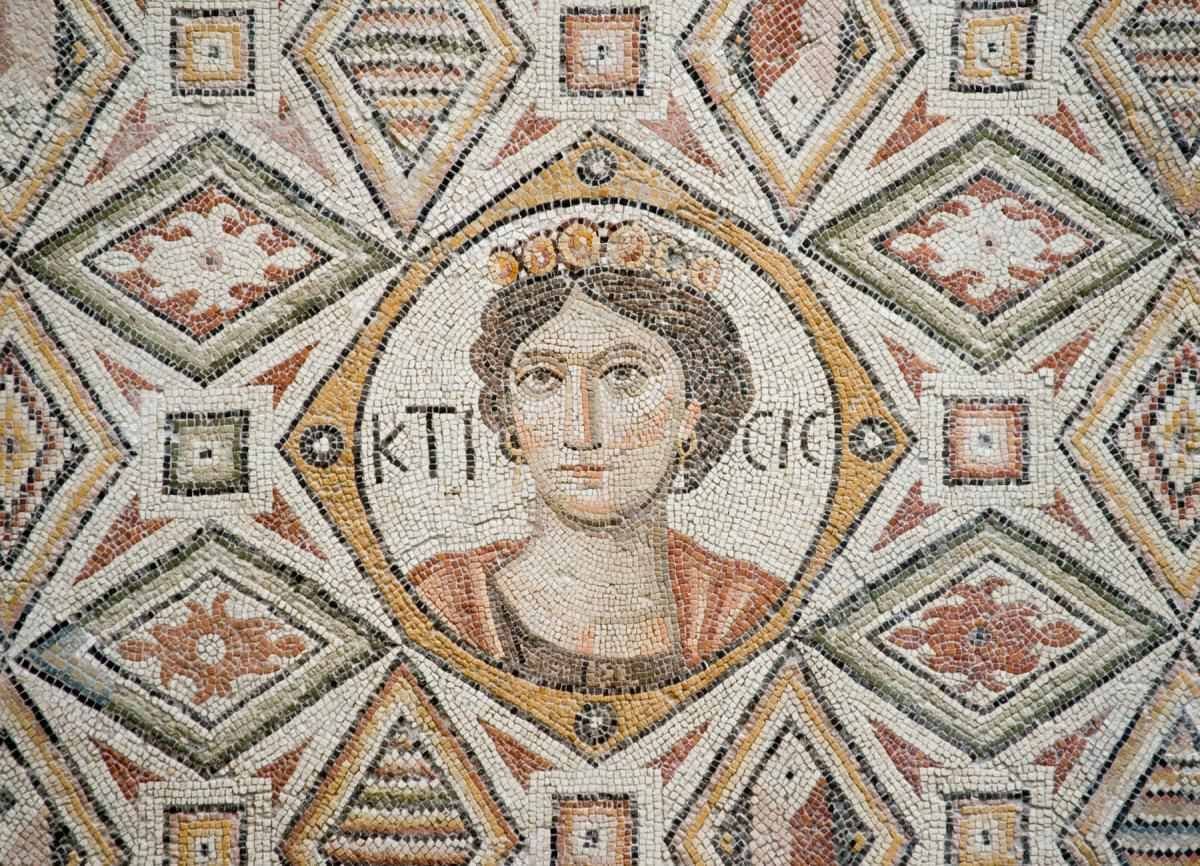
| Title | Personification of Ktisis |
| Year | 5th century AD |
| Type | floor mosaic (Cubes of marble and limestone embedded in lime mortar) |
| Dimensions | 285.3 x 276.9 cm (112 5/16 x 109 in |
| Location | Worcester Art Museum |
Antioch was one of the major artistic -and cultural in general- centers of the ancient world and the early Byzantine world. Indeed, it was only after Antioch and Alexandria fell to the Arabs that Constantinople emerged as the only undisputed artistic capital of the Byzantine state.
This wonderful mosaic presents “Ktisis” (ΚΤΙCIC), the personification of abstract notions like Creation, Building, and Founding -even the World, as “The Creation” of god- and it is a common theme in early Byzantine art, often found in floor mosaics all over Eastern Mediterranean.
In center of a geometrical design, often found in Coptic and Syrian tapestries of the same period, is a medallion with a female head (personified foundation of the house). This medallion had the same signature as corner-stone, border of ducks and lotus flowers (similar to border in apse of San Giovanni in Laterano, Rome). It was found in Antioch, in a villa destroyed by the devastating Antioch Earthquake in 526 that killed 250.000 people

This article is published on ArtAddict Gallery where we explore the intersections of art, history, and culture. Stay with us for more insights and discoveries!