Text by Vincent DeLuise Author, Educator, Musician at amusicalvision.blogspot.com, Cultural Ambassador, Waterbury Symphony Orchestra
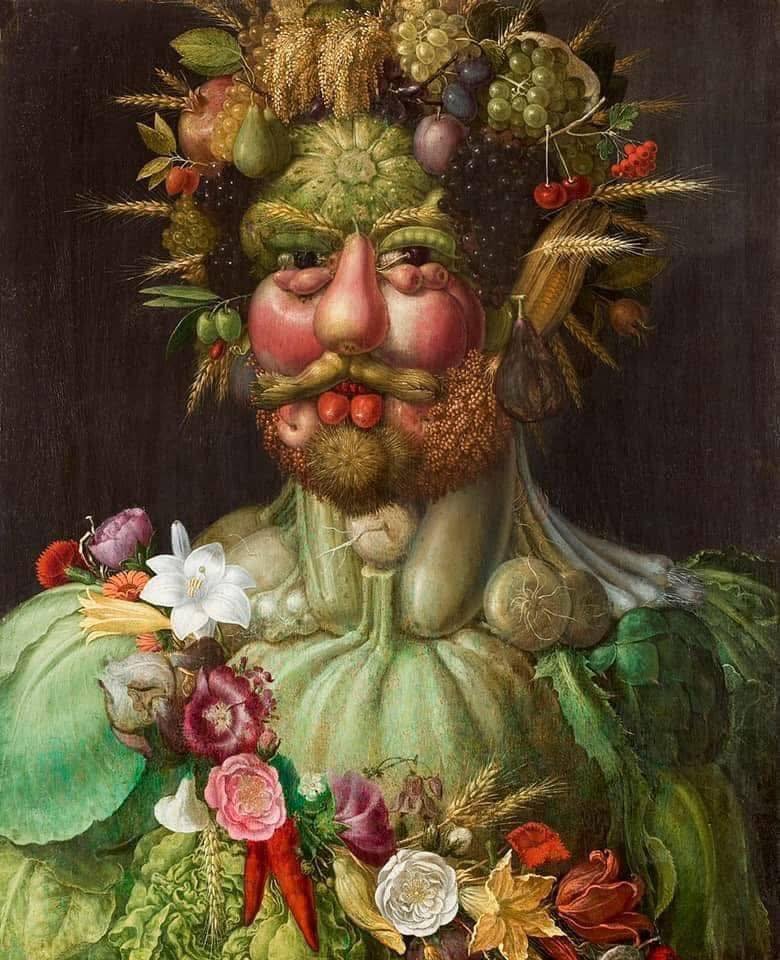
| Artist | Giuseppe Arcimboldo |
|---|---|
| Title | Rudolf II of Habsburg as Vertumnus |
| Year | 1590 |
| Type | oil on panel |
| Dimensions | 68 X 56 cm (26.77 X 22.05 in) |
| Location | Skokloster Castle, Håbo, Sweden |
My interest, as an ophthalmologist, in Giuseppe Arcimboldo’s trompe l’oeil paintings is not only as an admirer of Renaissance Art, but moreso in regards to their relationship to the domain of visual perception.
Why do we immediately “see” a facial pattern in this painting?
Why do we immediately “see” a face in many of Arcimboldo’s remarkable portraits, when if we deconstruct them, they are nothing more than a strategically arranged bunch of vegetables or fruits or books or whatnot ?
The answer is complex, but cognitive neuroscientists now agree that it has a lot to do with memory and comparison.
From birth, we are neurologically “hardwired” for faces and for symmetry.
Infants at two days of age already preferentially gaze at symmetrical faces than at asymmetrical faces.
Our brain’s hippocampus and limbic system neural networks store memories of “faces” and we immediately (< 400 msec) subconsciously compare images to what we “know.
Giuseppe Arcimboldo, nicknamed, “il Meraviglioso” (the Marvelous 1526-1593),
was court painter to three Holy Roman Emporers in Vienna.
In addition to his magisterial work in portraying the aristocracy and assorted nobles, he was a singularly visionary Mannerist painter who astonished the Court with fascinating and archetypal trompe l’oeil portraits.
He painted this well recognized work in Milan in 1590–1591.
This painting is arguably Arcimboldo’s most famous work and is a portrait of the Holy Roman Emperor Rudolf II re-imagined as Vertumnus, the Roman god of metamorphoses in nature and in life.
“Although Arcimboldo’s colleagues commented that Vertumnus was a scherzo ( a humorous work created as a joke), there were intentional political meanings behind the painting, particularly regarding the choice of fruits, vegetables, and flowers. Arcimboldo’s choice to include these items was also an intentional reference to the Roman god, Vertumnus.”
Vertumnus was god of the seasons, nature, metamorphosis and plant growth. His manifestations were protean.
So what do we “see”?
If we deconstruct the painting,
we see that Emperor Rudolph is created out of plants, flowers and fruits from all seasons: gourds, pears, apples, cherries, grapes, wheat, artichokes, beans, peas, corns, onions, cabbage foils, chestnuts, figs, mulberries, plums, pomegranates, various pumpkins and olives.”
During Rudolf II’s twenty-nine year rule in Hungary and Bohemia, art was celebrated and praised. His time as Holy Roman Emperor, now named “Rudolfine Prague”, set an unprecedented era for the appreciation of art, with much of this cultivation pushed by Rudolf II himself.
“This acceptance of art is what allowed Arcimboldo to thrive in his court, especially with the unprecedented, unique style Arcimboldo came to be known for.
“The initial impression of Arcimboldo’s Vertumnus was that it was joke due to the whimsical nature of the piece.
“However, Vertumnus was not meant to be presented only as a joke.
“Rather, the use of fruits and vegetables were meant to display Rudolph II’s “metamorphoses of power over the world for a ruler”.
“ The imperial patron behind Vertumnus, the specific fruit choices that act as power propaganda, and the copies of Vertumnus that were distributed throughout Europe, “all suggest their role as political allegories.”
Rudolf II’s portrait itself encapsulated the perfect balance and harmony with nature, arts, and science, all of which Rudolf II believed he represented during his reign.
“These portraits were an expression of the Renaissance mind’s fascination with riddles, puzzles, and the bizarre. The search for unique, fascinating pieces of art was a common trend among Renaissance elites which lent Arcimboldo the perfect opportunity to fascinate viewers with his distinctive style.
“Although Arcimboldo’s traditional religious subjects were later forgotten, his portraits of human heads composed of objects were greatly admired by his contemporaries.”
References:
1) wiki articles on Arcimboldo and on Vertumnus
2) Andreja Bubic et al, Perception 2014
Keeping our eyes on the eyes: the case of Arcimboldo . Journal of Percerption
https://pubmed.ncbi.nlm.nih.gov/25109013/
3) Boccia et al. J Atten Percep Psychophysics
Why do you like Arcimboldo’s portraits? Effect of perceptual style on aesthetic appreciation of ambiguous artworks . 2014
https://pubmed.ncbi.nlm.nih.gov/25085737/
4) Boccia et al. J Brain Behavior Research 2015
Do you like Arcimboldo’s? Esthetic appreciation modulates brain activity in solving perceptual ambiguity
https://pubmed.ncbi.nlm.nih.gov/25289490
High Resolution and Zooomable Image
https://artsandculture.google.com/…/TAGn3nhWHkbIBA…
Click on fhe image to see it in full

This article is published on ArtAddict Gallery where we explore the intersections of art, history, and culture. Stay with us for more insights and discoveries!